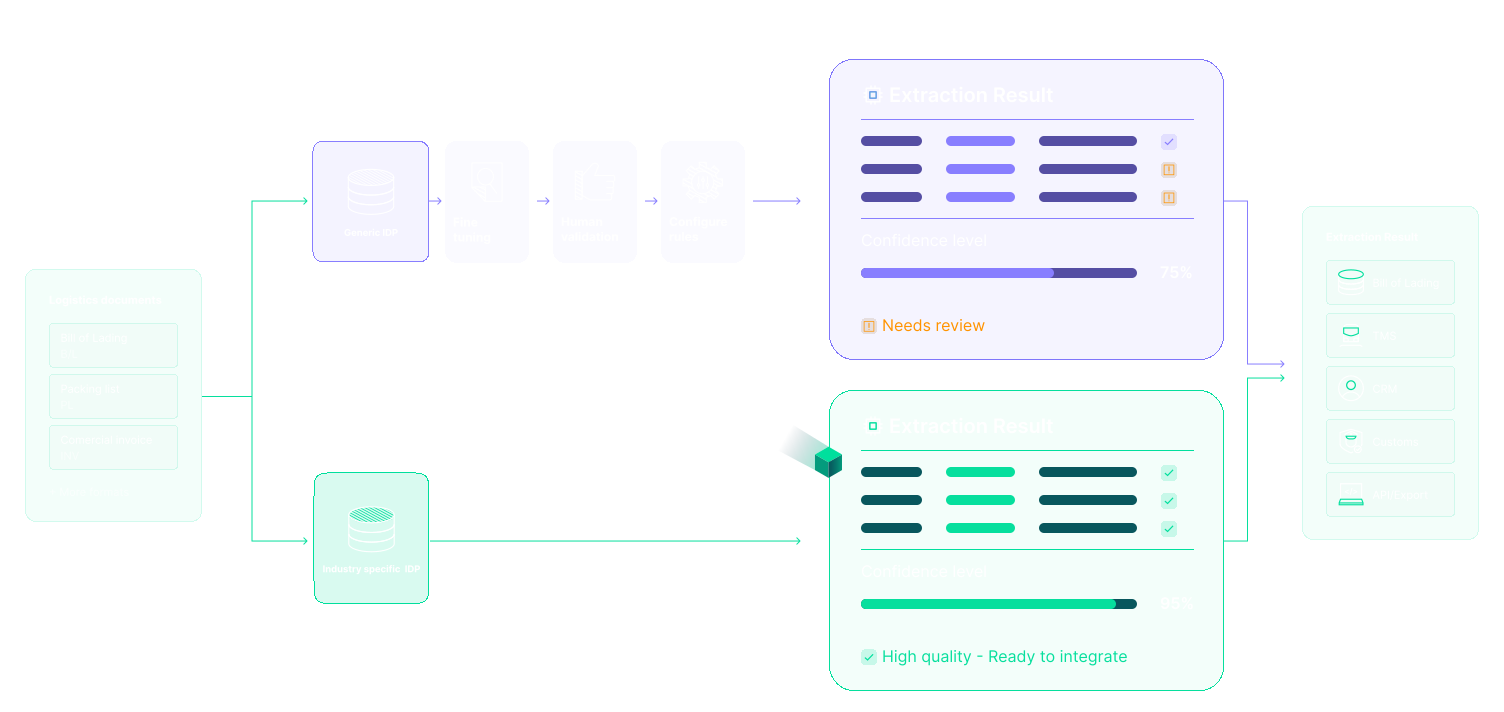

It’s 2026 and global supply chains still run on millions of documents within thousands of non-standardized processes across decentralized systems. From packing lists sent via e-mail, customs declarations that need to be transformed into error-free audit-ready data sheets and multi-page commercial invoices for Accounts Payable (AP) processes: use cases span across departments.
Today, manual data entry causes freight delays, compliance errors, and bloated operational costs for freight forwarders and customs brokers.
To solve this, more and more companies from the sector are turning to the Intelligent Document Processing (IDP) market to get rid of manual data entry errors and free up their team’s time for higher-value tasks. But with hundreds of vendors promising all-in-one AI extraction, finding the right fit is complex. A tool that perfectly extracts data from a standardized financial receipt will often fail when handed a coffee-stained packing list.
In this guide, we will take a look at the IDP landscape, compare four notable solutions, and explore why generic tools often fall short on the demands of supply chain management.
Understanding the IDP market landscape
According to frameworks like the Gartner Magic Quadrant, enterprise software generally falls into four categories: Leaders, Challengers, Visionaries, and Niche players.
When evaluating IDP for logistics, this segmentation is critical.
Let’s take a look at two of these segments and how they differ from one another:
| Leaders (tech giants) | Industry-agnostic platforms designed to serve everyone from healthcare to retail. They offer immense scalability but require significant IT resources to train them on specialized logistics documents. |
| Niche players (industry specialists) | Solutions focused entirely on a single vertical. For organizations dealing with highly specific, non-standard workflows – like global freight – these specialized tools often yield a much faster Return on Investment (ROI) because they understand the industry context out-of-the-box. |
4 IDP solutions evaluated for logistics in 2026
To understand the market, let’s evaluate four notable platforms, their optimal use case, and how they fit into a complex logistics environment.
1. ABBYY Vantage (Enterprise Giant)
ABBYY is a legacy powerhouse in the OCR and IDP space. Offering a big ecosystem of 200+ pre-trained AI models, users can extract data from common document types like invoices and receipts.
Best for: Big, multinational enterprises with heavy IT resources looking for a single, centralized tool across all departments.
The logistics challenge: Highly complex – building custom workflows for freight documents requires a steep learning curve and significant setup time.
2. Rossum (Accounts Payable Specialist)
Rossum is a brilliant cloud-native IDP solution famous for its template-free architecture, specifically designed for transactional documents in which users can define which data is needed and how it should be formatted, validated, and enriched based on specific rules.
Best for: Enterprise AP automation and financial departments processing standardized transactional documents (invoices, purchase orders).
The logistics challenge: While it integrates beautifully with SAP and Oracle for finance, it is not inherently designed to parse the operational complexities of packing lists or cross-border customs declarations.
3. Unstract (LLM Innovator)
Unstract uses large language models (like OpenAI and Claude) to extract context-aware data. Through a prompt-driven, no-code interface, users can simply describe which information should be processed, transforming data into structured JSON or string responses.
Best for: Insurance, finance, and teams looking for a no-code way to query unstructured data.
The logistics challenge: While highly flexible, relying purely on broad LLMs can sometimes lack the accuracy required for critical supply chain routing and compliance.
4. LumoDoc (High-Volume Logistics Specialist)
LumoDoc is designed exclusively for the logistics and transportation sector. Rather than serving every industry, it’s pre-trained on high-quality operational logistics data, capable of recognizing over 14 specific document types (including Bills of Lading, packing lists, and customs paperwork).
Best for: Freight forwarders, carriers, and 3PLs who need rapid deployment, extremely high accuracy on messy operational documents, and TMS integration.
The logistics advantage: It is ready to perform with 95% extraction accuracy out-of-the box and requires no training because it already speaks logistics.
Defining the right solution fit
| Feature / Capability | Enterprise generalists (e.g. ABBYY) | Logistics specialists (e.g. LumoDoc) |
| Setup & implementation time | Months (high IT involvement) | Days (out-of-the-box models) |
| Out-of-the-box logistics models | Low | Very high (14+ Document types) |
| Transport Management System (TMS) integration | Custom build required | Built-in / Highly flexible |
| Total cost of ownership | Very high | Cost-effective & high ROI |
Why industry-specific AI wins in logistics
Generic IDP solutions struggle with the variety and missing standardization of global freight documentation. Choosing a platform that is specialized and trained on high-quality operational logistics data prevents your team from spending months on training AI to identify complex and varied document types.
With LumoDoc, we believe logistics companies shouldn’t have to change their workflows to fit their software. By offering personalized data mapping, data output templates, and custom TMS integrations, we allow you to decide exactly how your data is structured and delivered.
The result? Our users report a 90% increase in processing efficiency and achieve 95%+ data extraction accuracy across their most complex document types.
Stop manually entering freight data – request a demo call