
In global supply chain management, operational resilience depends largely on how fast your data moves. However, the operational burden remains incredibly high, with each shipment requiring extensive paperwork including: international bills of lading, packing lists, commercial invoices, and customs declarations.
For players in the logistics industry trying to scale operations, this manual workload creates immediate operational friction that slows down the entire supply chain.
Teams are confronted with three core bottlenecks:
- Human error-prone manual tasks:
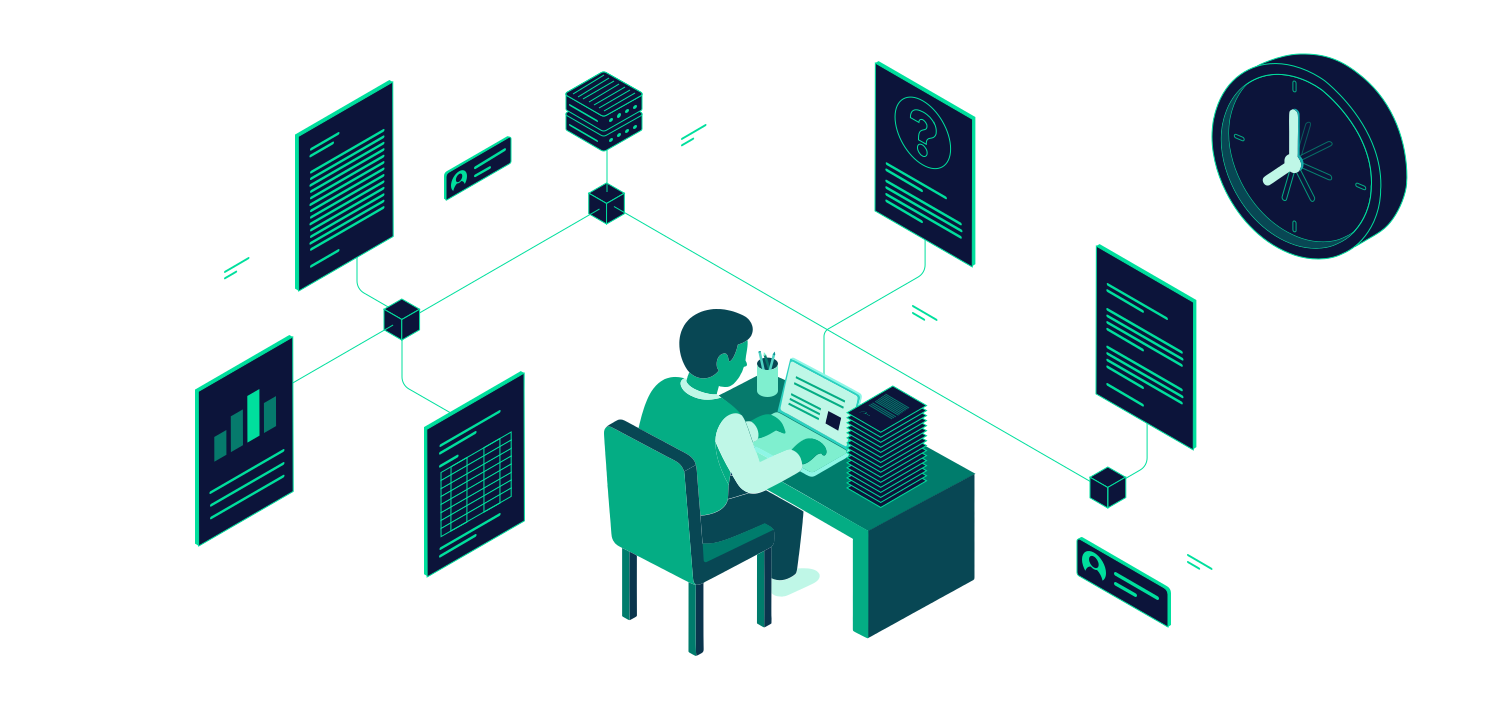
Relying on operators to manually copy and paste lines of complex data into a Transportation Management System (TMS) introduces costly typographical errors, billing discrepancies, and customs non-compliance. - Systemic document bottlenecks:
Manual data entry creates severe backlogs during peak shipping seasons. Documents sit in inboxes for hours, stalling cargo movement and driving up demurrage fees. - Layout instability:
Global trade documents are entirely unpredictable. A supplier changing a font or a carrier updating a table layout overnight completely breaks traditional rule-based data extraction engines.
To solve these bottlenecks, the initial impulse for many leaders is to build an internal Intelligent Document Processing (IDP) tool. It feels logical: you retain absolute control and keep the tech in-house. In time, product and operations teams soon discover that the true cost of an AI solution isn’t the initial build. It’s the permanent engineering commitment required to maintain it.
Let’s dive into the hidden costs of building in-house versus the strategic value of buying a specialized tool like LumoDoc.
The hidden costs of building in-house
When you commit to building a custom document parser or IDP, you take on massive technical debt. Internal IT teams often underestimate the sheer infrastructure required to keep an IDP system running in a shifting global market.
1. The engineering opportunity cost
Building a production-ready IDP solution requires a multi-disciplinary team. Specialized AI engineers are expensive and difficult to hire, and getting a functional prototype off the ground typically drains 6 to 12 months of engineering time. Furthermore, every hour your developers spend building OCR preprocessing pipelines, configuring batching logic, or managing document queues is an hour stolen from improving your core logistics product.
2. The maintenance tax & schema drift
In logistics, document formats are never static. Traditional internal tools rely on rigid templates and rules. When a supplier changes a layout or a tax field overnight, you hit the “schema drift” trap. The system breaks, documents pile up, and it requires urgent IT intervention to avoid operational delays.
6–12 Months
The average time it takes an internal IT team to deploy a baseline document parser, diverting crucial resources from your core product.
3. UI burdens invisible errors
Internal developers often celebrate when their AI hits a 90% or 95% accuracy rate. However, if an internal tool lacks a dedicated interface to flag the remaining 5% to 10% it got wrong, those errors remain completely invisible. Then your team needs to manually hunt down mistakes. Essentially, you haven’t eliminated manual review; you have just disguised it. Building the invisible frontend infrastructure to support human review is a massive, highly complex undertaking.
4. Integration and infrastructure complexity
Moving data from a raw document to your ERP/TMS is an integration challenge that requires sophisticated engineering. If your internal backend logic for prioritizing (queueing) and executing (batching) requests isn’t flawless, your internal system will crash during high-volume peak seasons.
5. The risk of obsolescence and compliance
Internal tools are often “built and forgotten,” quickly becoming obsolete as AI evolves. Furthermore, internal teams relying on general-purpose LLMs (like ChatGPT or Gemini) often overlook strict industry requirements. Customer data can inadvertently be used for model training, exposing the company to severe data liability and leaving you with zero corporate audit trails.
The value of buying: the LumoDoc advantage
For an ambitious logistics provider, your core competency is moving cargo, not maintaining digital infrastructures. By partnering with FortoLabs and deploying LumoDoc, you shift the engineering risk to a dedicated Agentic AI platform and unlock immediate operational value.
1. Zero-shot understanding (speed to value)
While internal projects face constant roadmap drift and require months of manual model training, LumoDoc offers Zero-Shot understanding. Trained on millions of real-world logistics documents from our own internal FlashDoc prototypes, our Agentic AI comprehends 14 standard logistics document types immediately, out of the box.
2. Layout-agnostic extraction (zero maintenance)
LumoDoc reads documents contextually, like a human. As it is layout-agnostic, it continues to extract data accurately even when suppliers completely change their formats. You outsource the 24/7 maintenance burden to our team, yielding a proven 90% efficiency gain for your operations floor.


3. Ready-to-use HITL UI
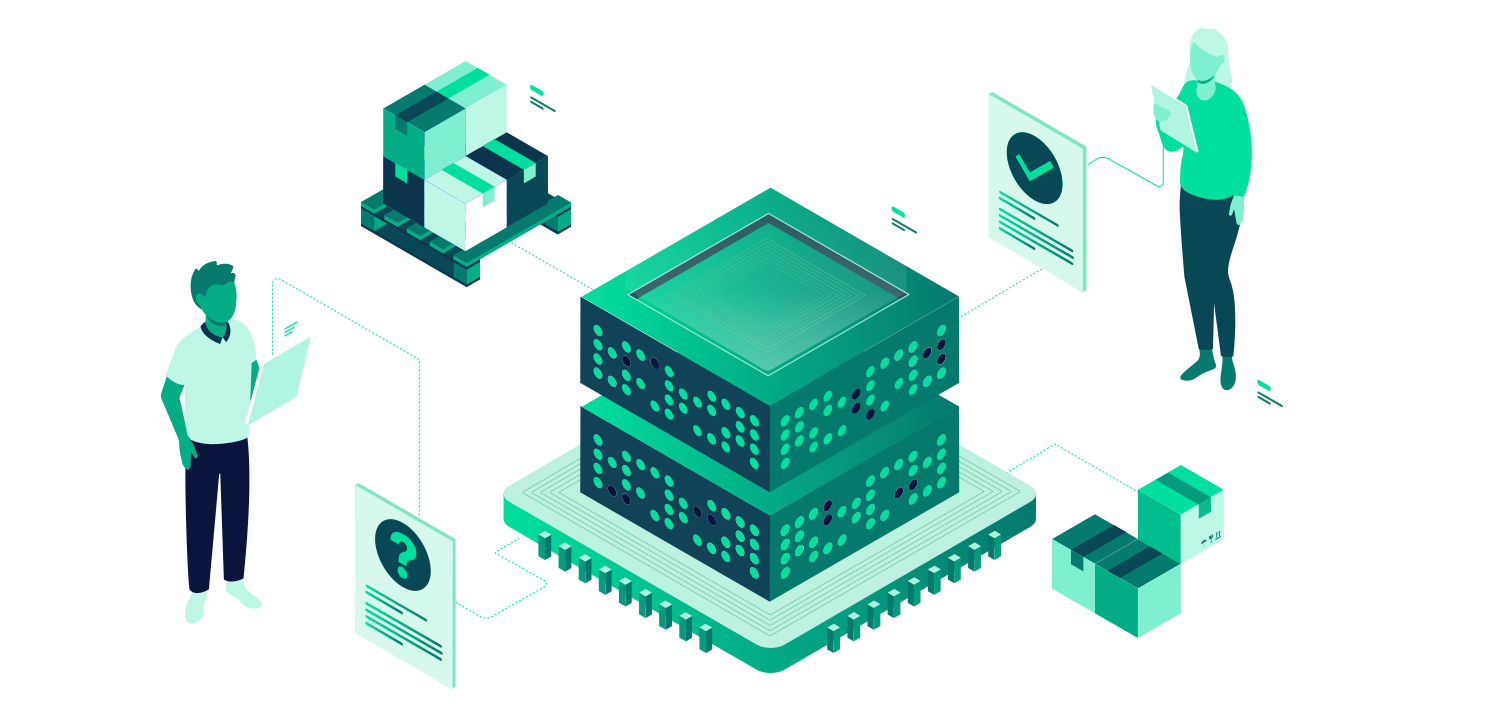
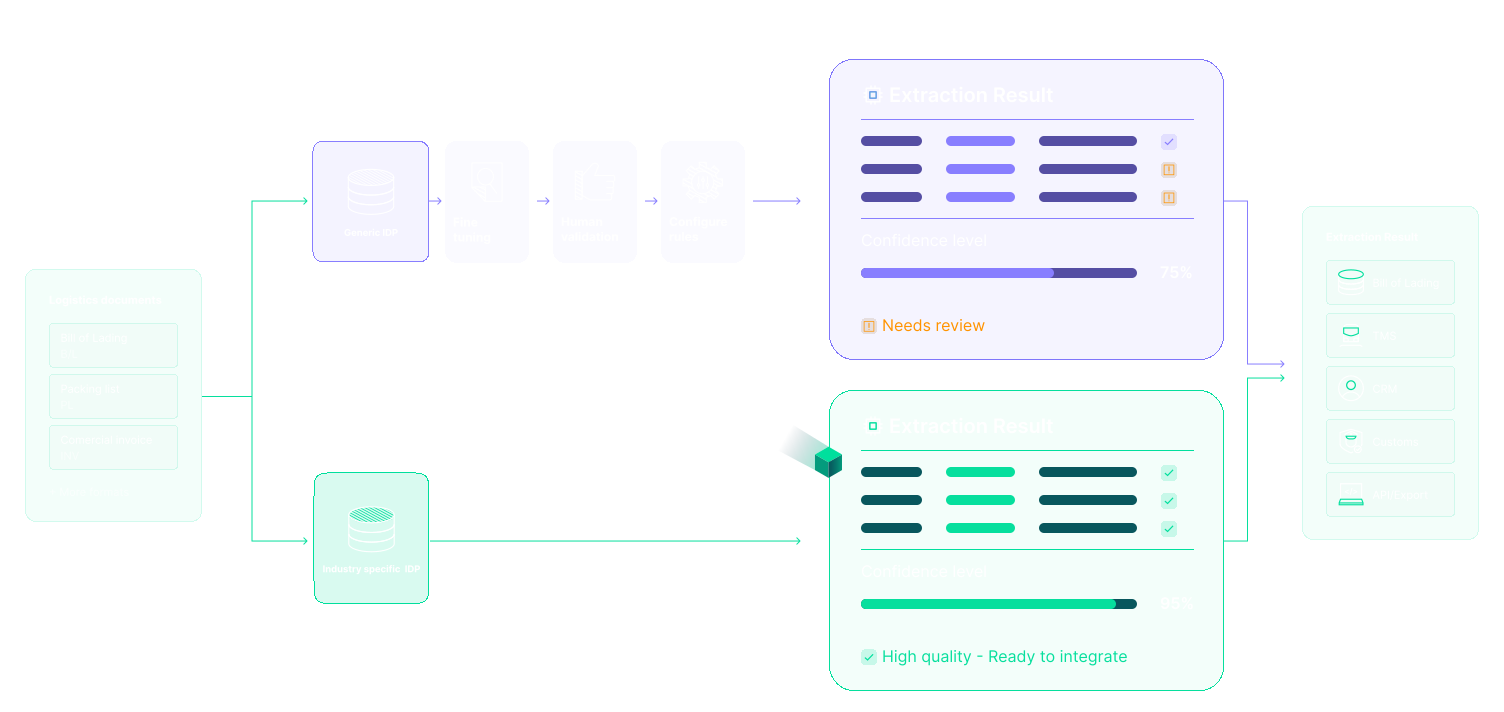
Effective automation requires a user interface operators can actually trust. LumoDoc solves the frontend burden right out of the box with a built-in Human-in-the-Loop (HITL) UI that displays extracted data fields side by side with the original document. Instead of forcing operators to hunt blindly for mistakes, the interface turns exception handling into a fast, visual review process through three core capabilities:
- Automated Confidence Scoring:
The AI instantly grades its own extraction accuracy. High-confidence data flows straight to your TMS, while low-confidence or uncertain fields are explicitly flagged for human review. This targeted flagging eliminates manual double-checking and brings down the HITL time considerably. - The “Pick-to-Review” highlighting feature:
Clicking any flagged field instantly highlights its exact text coordinates on the PDF side by side. Operators can verify data instantly without scrolling through a multi-page commercial invoice. - Custom data mapping:
For complex edge cases, users can customize field names or literally click and drag a bounding box over specific text on the document to snap it into the system on the fly. This completely eliminates manual typing for exceptions without requiring any IT intervention.
Surfacing and resolving exceptions visually makes the review process 5x faster. With LumoDoc handling the heavy lifting and streamlining the edge cases, your team can seamlessly handle 3x the document volume without adding to your operational headcount.
5x faster
This is how much quicker operators can resolve data exceptions using LumoDoc’s Confidence Scoring and visual coordinate highlighting.
4. Invisible, resilient API integration
LumoDoc guarantees operational resilience. We manage the complex backend queueing and batching to ensure flawless execution during peak volume. Through seamless API integration (achievable in just 2 weeks), LumoDoc works in the background, feeding data directly into your existing TMS fields so your team never has to learn new software.
5. Data sovereignty & multi-horizon future-proofing
Data privacy is non-negotiable. Zero customer data is ever used to train LumoDoc’s underlying AI models, and every extraction includes a full audit trail (who processed what, when, and at what confidence level). Furthermore, LumoDoc is on an ambitious multi-year roadmap (2025–2028+) to deploy AI Agents for automated validation and output consolidation.
Features at a glance: build vs buy for IDP software
| Capability | Build in-house | LumoDoc by FortoLabs |
| Time to Value | 6 to 12 months of custom development | Immediate UI access & fast API integration |
| Exception Handling | Manual IT triage when layouts break | Built-in Human-in-the-Loop (HITL) interface |
| Layout Resilience | High failure rate; rigid OCR rules | Layout-agnostic extraction via Agentic AI |
| Maintenance Burden | Permanent internal engineering tax | Upkeep handled entirely by FortoLabs |
| Data Security | High compliance liability & weak audit trails | Strict privacy rules; no customer data used for training |
| Cost Structure | High fixed salaries for AI developers | Predictable, flexible pay-per-page volume pricing |
Conclusion: benchmark and run a pilot before you build in-house
Building your own IDP solution feels like a massive win on day one. Unfortunately, that permanent maintenance tax will quickly burn out your IT team and slow down your operations. When margins are tight and speed is everything, your engineers need to focus on building features that actually win market share.
By plugging into LumoDoc, you get the absolute best of both worlds. You get an enterprise grade Agentic AI that adapts to layout changes on the fly. Plus, you get a ready to use UI that empowers your ops team to move faster instead of hunting blindly for errors.
The best part is you do not have to rip and replace your current system to see the difference. Just get in touch with our team and learn how LumoDoc compares to your current setup.
Interested to discover your potential ROI with LumoDoc?
Calculate your time & cost savings now.